Targeted Cancer Therapies
What are Targeted Cancer Therapies?
Targeted cancer therapies use drugs to more precisely identify and attack cancer cells, based on a person’s genes, as compared to traditional cancer treatments. As such, targeted cancer therapies are sometimes called “molecularly targeted drugs” or “molecularly targeted therapies” and allow for a more precision medicine approach.
In addition to being molecularly-focused, targeted therapies are often cytostatic (which means they block tumor cell proliferation), whereas standard chemotherapy agents are cytotoxic (which means they kill tumor cells). Therefore, many targeted drugs go after the mechanisms that make cancer cells different than normal cells and leave the healthy cells alone.
Support Breakthroughs in Targeted Cancer Therapies
Cancer Research and Beyond.
Researchers Working On Targeted Cancer Therapies





Related Content
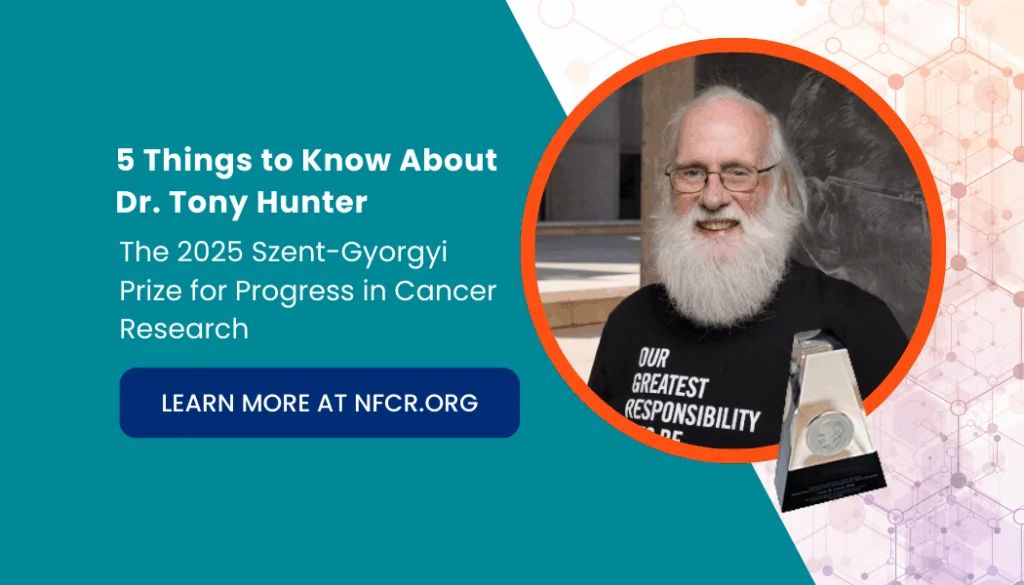
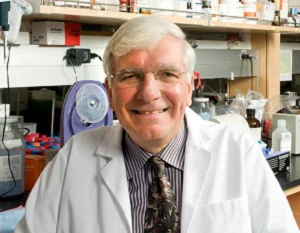
5 Things to Know About Dr. Tony Hunter
Dr. Tony Hunter of the Salk Institute is well-known for discovering the cellular process of tyrosine phosphorylation and how miscues in this signaling pathway can lead to unchecked cell growth. The results of his discovery are the development of the blueprint for targeted cancer therapies and more than 50 FDA-approved tyrosine kinase inhibitors (TKIs). On Friday, October 24, 2025, Dr. Hunter will be awarded the 2025 Szent-Gyorgyi Prize for Progress in Cancer Research at the NFCR Global Summit and Award Ceremonies in Washington, DC. Ahead of this event, we get to know Dr. Hunter a little bit better. Here are 5 things you should know about Dr. Tony Hunter: Dr. Hunter received his education at the University of Cambridge and came to the U.S. as a postdoctoral trainee at the Salk Institute, where he continues his vital work today, 50 years later. While at the University of Cambridge, Dr. Hunter studied under two Nobel Prize Winners: Fred Sanger and Max Perutz. He credits these two as major influences on the direction of his career. The most well-known cancer therapy developed as a result of his work is Gleevec, which revolutionized treatment for chronic myeloid leukemia and has saved hundreds of thousands of lives worldwide. He has earned recognition at the highest level in seven different countries (the US, Canada, Britain, Sweden, Spain, Thailand, Japan), demonstrating his global impact. Some of these distinctions include being elected to the National Academy of Sciences and the National Academy of Medicine in the U.S. Today, Dr. Hunter’s lab is advancing research on one of the toughest challenges in oncology, pancreatic cancer. His team discovered that cancer-associated fibroblasts secrete a signaling molecule called leukemia inhibitory factor (LIF) that helps tumors resist treatment. By blocking LIF, they slowed tumor growth and improved chemotherapy responses in animal models. Elevated LIF levels are also linked to more aggressive disease in patients, suggesting LIF is both a biomarker and a promising therapeutic target. Join Us in Honoring Dr. Hunter’s Contributions to Saving Cancer Patients’ Lives Hear Dr. Hunter speak about his research and his pathway to discovery at the 2025 NFCR Global Summit and Award Ceremonies for Cancer Research and Entrepreneurship. NFCR's Global Summit is unlike any other event because attendees have the chance to ask questions, advance the conversation, and network with other researchers and leaders like Dr. Hunter. Tickets will sell out, so reserve your spot today! Sign-up to Stay Informed About Cancer Research Breakthroughs with NFCR! A world without cancer is possible. Help us turn lab breakthroughs into life-saving realities. 5.7 Million+ Donors who have fueled NFCR's mission $420 Million+ Invested in high-impact research & programs 36+ Labs & Hundreds of Nobel Laureates & Key Scientists received NFCR funding, driving breakthrough research {{ vc_btn: title=MAKE+THE+DIFFERENCE&style=outline-custom&outline_custom_color=%23FF5012&outline_custom_hover_background=%23FFFFFF&outline_custom_hover_text=%23002C76&align=center&link=url%3Ahttps%253A%252F%252Fdev.nfcr.org%252Fmake-the-difference%252F }}Sign-up to Stay Informed About Cancer Research Breakthroughs with NFCR!
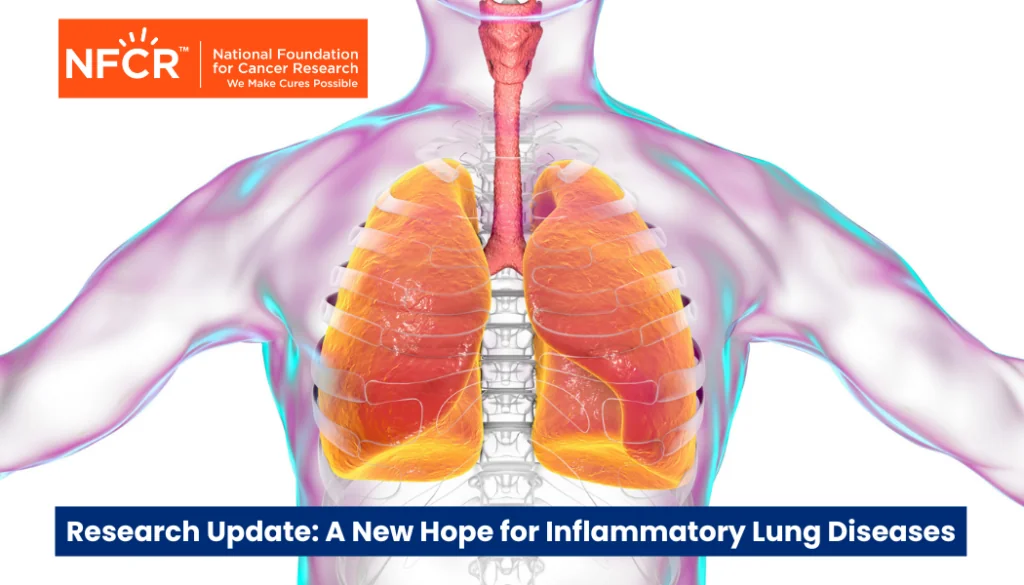
Research Update: A New Hope for Inflammatory Lung Diseases
A new treatment may soon bring relief to people suffering from pulmonary sarcoidosis, a serious lung disease with few good treatment options. The discovery comes from research led by Dr. Paul Schimmel of Scripps Research, a longtime scientist supported by the National Foundation for Cancer Research (NFCR). The team’s findings were recently published in Science Translational Medicine. What is Pulmonary Sarcoidosis? Sarcoidosis is a type of interstitial lung disease (ILD) where the immune system goes into overdrive, forming clusters of inflammatory cells—called granulomas—in the lungs. These can cause scarring and breathing problems. Current treatments mainly rely on steroids, which can have serious side effects like weight gain, bone loss, and a higher risk of infections. Is sarcoidosis cancer? It is not considered cancer but sometimes is mistaken as such. What Did Paul Schimmel & Team Discover? Dr. Schimmel’s team created a new therapy called efzofitimod, based on a natural protein found in lung tissue. This engineered version is designed to calm the immune system in a more targeted way. Instead of shutting down the whole immune system like steroids do, efzofitimod focuses on specific immune cells that cause inflammation. Efzofitimod works by attaching to a receptor called neuropilin-2 (NRP2), found on certain immune cells that become overactive in lung disease. This helps reduce inflammation and lung damage while keeping the rest of the immune system working normally. In lab and animal studies, efzofitimod reduced inflammation and scarring in several types of ILD. In a small clinical trial, patients with sarcoidosis were able to lower their steroid doses while keeping their lung function stable and reducing inflammatory markers. “This isn’t a drug that shuts down the immune system,” said Dr. Leslie Nangle, co-lead author of the study. “It guides the immune response in a gentler, more natural way.” While the study focused on sarcoidosis, scientists believe efzofitimod could also help people with other inflammatory lung diseases. It may even lead to a new class of more targeted immune therapies. This research was partly supported by NFCR, showing how cancer research can lead to breakthroughs in other diseases, too. Make a Gift Today to Support Breakthroughs in Cancer Research>>> About Paul Schimmel Dr. Paul Schimmel, a distinguished biophysical chemist, has been collaborating with the National Foundation for Cancer Research (NFCR) since 1994. His research focuses on aminoacyl-tRNA synthetases (aaRS), enzymes crucial for gene expression. Supported by NFCR funding, Dr. Schimmel and his collaborator, Dr. Xiang-Lei Yang, have uncovered that certain aaRS enzymes are linked to diseases such as chronic and acute inflammation, neuropathy, and cancer progression. Notably, their work on SerRS has demonstrated its potential as an anti-tumor and anti-metastasis agent, offering promising avenues for cancer therapy. Sign-up to Stay Informed About Cancer Research Breakthroughs with NFCR! A world without cancer is possible. Help us turn lab breakthroughs into life-saving realities. 5.7 Million+ Donors who have fueled NFCR's mission $420 Million+ Invested in high-impact research & programs 36+ Labs & Hundreds of Nobel Laureates & Key Scientists received NFCR funding, driving breakthrough research {{ vc_btn: title=MAKE+THE+DIFFERENCE&style=outline-custom&outline_custom_color=%23FF5012&outline_custom_hover_background=%23FFFFFF&outline_custom_hover_text=%23002C76&align=center&link=url%3Ahttps%253A%252F%252Fdev.nfcr.org%252Fmake-the-difference%252F }}Sign-up to Stay Informed About Cancer Research Breakthroughs with NFCR!

The Future of Your Health Begins with Precision Medicine
“One-Size-DOES NOT-Fit-All” ‘You wouldn’t wear just any pair of glasses – your prescription is tailored to your vision’1. This statement alludes to and embraces the importance of an individual’s unique characteristics: genetics, health history, lifestyle, diet, or geographic location. Just as you would expect your doctor to match a blood transfusion to a blood type, wouldn’t you want your health care tailored uniquely to you in other ways if that were possible? The answer is likely YES. This is the foundation of precision medicine, a customized treatment plan based on an individual’s unique characteristics and developed using advanced technology. How Does Precision Medicine Use Advanced Technology to Match a Cancer Treatment to a Patient? While all humans are alike, variations in DNA blueprints are what differentiate one from another, and in certain individuals those variations may be the root cause of some illnesses, including cancer. Modern computational technology has made it possible for scientists to analyze the gigantic sets of codes in our DNA that affect human health and to identify tiny variations in that code. This is Precision Medicine. How Does Targeted Therapy Rely on Precision Medicine? Because cancer may be considered a disease of genomics, or one’s DNA, we now have the technology and knowledge to pinpoint where the change in genomics occurred and caused certain cancers. This helps us to design cancer treatments specifically targeting those abnormalities in cancer cells without harming adjacent normal cells. This is Targeted Therapy. As an example, scientists have learned the genomic alteration related to lung cancer patients and are exploring how using targeted therapy shapes the way we treat lung cancer. One of the genes that is abnormal and might cause cancer is MET (c-MET; MET-EXON 14)2. What Is MET and How is it Related to Cancer? c-MET is a protein (MET gene) we all have in our body that plays a role in normal cell growth. Sometimes, for an unknown reason, MET gets altered and can contribute to cancer. Recent research suggests that these alterations in the MET gene (e.g., Exon 14 skipping, amplification or fusion) are often found in patients with lung cancer and other types of solid tumor cancers. Therefore, inhibiting abnormal MET pathways is considered an important focus area for developing new targeted therapies. A Clinical Trial Targeting MET The SPARTA Clinical Trial is exploring an investigational drug (APL-101) that targets tumor cells expressing one or more MET genetic abnormalities in hopes to cause tumor cell death and shrink or halt cancer cell growth in various advanced cancer types. APL-101 has been studied in participants with advanced solid tumors (including glioblastoma; gastrointestinal cancers; lung cancer) in a Phase 1/2 global clinical trial enrolling in 14 countries around the world3. To be eligible for the SPARTA Study, patients must qualify for the prerequisite criteria including a diagnosis with advanced tumors and have one (or more) of the following alterations in their MET gene: MET Exon 14 skipping mutation, MET Amplification, MET-gene Fusions. To learn more about investigational options for patients with MET aberrated cancers, visit: https://spartacancertrial.com/. You should consult your doctor to discuss the possible benefits and ways [...]