
Associate Professor
The University of Texas MD Anderson Cancer Center
Cancer-Types Supported
Click a cancer type below to learn more:
Research Projects
Virtual Centre & Distributed Computing Strategy for Rational Anti-Cancer Drug Design
Computational approaches to anti-cancer drug discovery address two fundamental components: the small-molecule drug and its biological macromolecular target (DNA or specific proteins). The Centre for Computational Drug Design, directed by Prof. W. Graham Richards, advances the discovery of novel therapeutics through an innovative “virtual centre” model based at the University of Oxford, linking international collaborators and utilizing massively distributed computational power.
Through the NFCR-initiated Screensaver Project, the Centre harnessed over 2.8 million personal computers, generating over 150 teraflops of processing power, to screen multi-million compound databases against critical biological targets. In partnership with spin-out venture Inhibox Ltd. and the DrugFinder screening platform, the Centre rapidly translates computational predictions into experimental testing and lead-like hit optimization.
Key Aims & Focus Areas
- Ultra-Fast Virtual Screening & Multi-Million Compound Databases: Constructing curated databases of over 6 million unique commercially available molecules (expanding to 100 million single-step virtual compounds) and enhancing virtual screening algorithms with molecular chirality and electrostatic similarity metrics.
- Targeting Cancer Kinases & Metabolic Pathways: Identifying novel lead-like inhibitors for key cancer drivers, including Protein Tyrosine Kinase 1B, cancer-associated protein kinases (in collaboration with Dr. Angela Russell), and Lactate Dehydrogenase A (LDH-A).
- Sequence-Specific DNA & Receptor Targets: Designing sequence-specific minor-groove binding molecules (e.g., ecteinascidin mimics) and evaluating signaling targets such as the Inositol 1,4,5-trisphosphate receptor.
- Enzyme Transition-State & Similarity Design: Applying QM/MM calculations and quantitative molecular similarity metrics (ASP) to design stable transition-state mimics for enzymes regulating tumor growth and angiogenesis.
- Structure-Activity & COMBINE Analysis: Employing pattern recognition, neural networks, genetic algorithms, and COMBINE analysis to evaluate lead optimization and predict drug transport across biological membranes.
Through this combination of global grid computing, proprietary screening algorithms, and industry-partnered experimental validation, the Centre provides a high-throughput, cost-effective framework to accelerate anti-cancer drug discovery.
Background
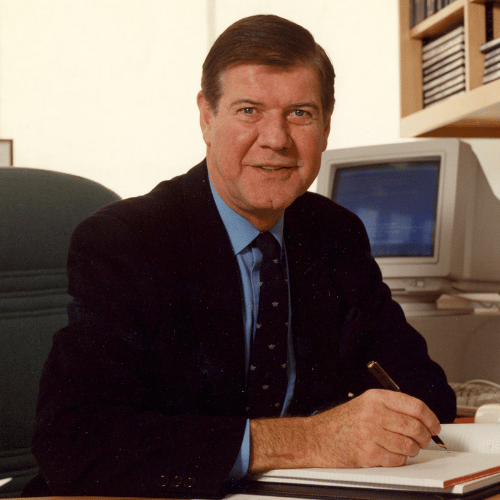
Professor W. Graham Richards, CBE, FRS (1939–2025) earned his B.A. and D.Phil. in Chemistry from Oxford, later becoming a Fellow of Brasenose College and serving as Professor of Chemistry and Head of the Department of Chemistry (1997–2006).
A pioneer of computational chemistry, Dr. Richards spent over four decades advancing computer-aided molecular design in drug discovery. NFCR began supporting his research in 1982 and, in 2001, partnered with him to establish the NFCR Centre for Computational Drug Design at Oxford. There he launched the Screensaver LifeSaver Project, which used idle computing power from millions of PCs worldwide to screen over 3.5 billion drug-like molecules against 12 cancer targets between 2000 and 2007.
He also co-founded Oxford Molecular Group plc and InhibOx Ltd., later donating 25% of his InhibOx shares to NFCR. His honors include a CBE (2001), Fellowship of the Royal Society (2018), and the Royal Society’s Mullard Award.
Years of NFCR Funding
1983 – 2010
Accelerate innovative research like this and help save cancer patients’ lives.