
Dr. Michele Carbone Awarded 2026 Szent-Györgyi Prize for Pioneering Cancer Research
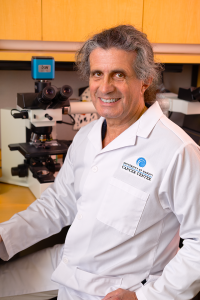
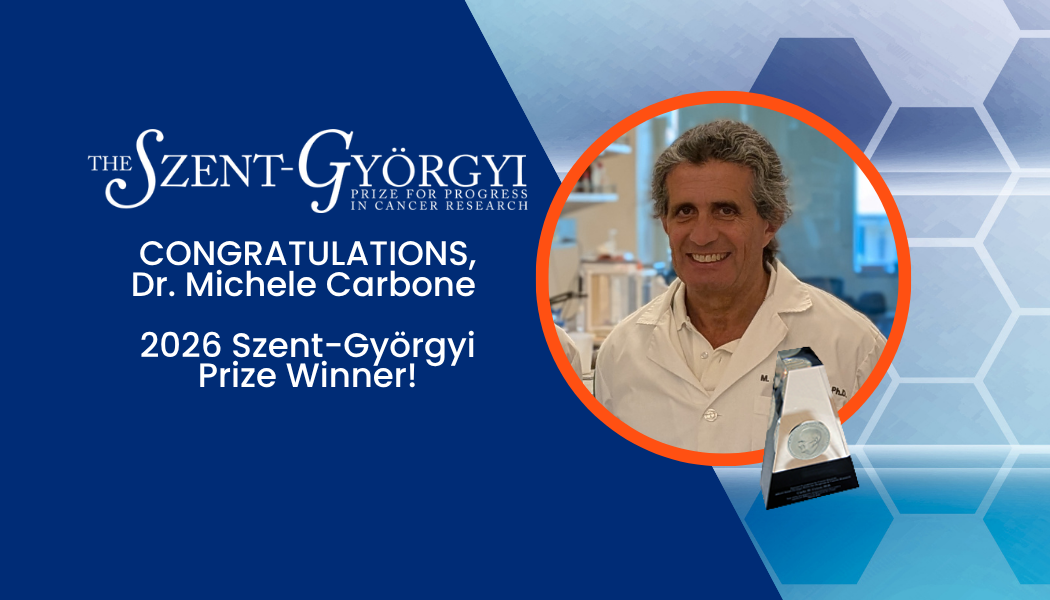
Rockville, MD — The National Foundation for Cancer Research (NFCR) is proud to announce that Dr. Michele Carbone of the University of Hawaii Cancer Center is the recipient of the 2026 Szent-Györgyi Prize for Progress in Cancer Research.
Dr. Michele Carbone receives the 2026 Szent-Györgyi Prize for Progress in Cancer Research, awarded by a blue-ribbon committee of 13 leading cancer researchers and clinicians, for his groundbreaking discovery that susceptibility to mesothelioma — a rare and lethal cancer of the lining of the lungs and abdomen — can be transmitted through families in a Mendelian fashion, driven by inherited mutations in the gene BAP1. Working for more than a decade in villages in Cappadocia, Turkey, where residents were heavily exposed to erionite, a carcinogenic mineral fiber, and where half of all residents died of mesothelioma, Dr. Carbone demonstrated that genetic predisposition, not environmental exposure alone, determined who developed the disease. He then identified germline BAP1 mutations as the cause of a novel cancer syndrome, characterized by mesothelioma alongside eye and skin melanoma, renal, breast, bladder, and other cancers. His subsequent elucidation of the molecular mechanisms of BAP1 tumor suppressor activity has reshaped the entire field of mesothelioma research.
Dr. Carbone’s findings have driven transformative public health action: in Cappadocia in Turkey, his research prompted the government to build two entirely new villages and hospitals and relocate genetically susceptible populations away from carcinogenic erionite fibers. In North Dakota, his work led the state government to repave more than 300 miles of erionite-contaminated roads, protecting children who had been exposed through dust raised by traffic. Today, BAP1 genetic testing and BAP1 immunohistochemical staining are standard practices in medicine worldwide, enabling clinicians to identify patients with the BAP1 cancer syndrome and implement personalized surveillance, early detection, and effective intervention. Patients with germline BAP1 mutations who are monitored and treated early survive significantly longer, and several of them died of old age, than those with sporadic mesothelioma — a disease that, when caused by asbestos, has a median survival of 6 to 18 months. The US National Cancer Institute has opened two clinical trials directly in response to his discoveries that validated his findings.
Dr. Carbone will receive the prize at the NFCR Global Summit and Award Ceremonies for Cancer Research & Entrepreneurship on October 9, 2026, at the National Press Club in Washington, D.C. This event unites the full cancer research ecosystem — from leading scientists, doctors, and entrepreneurs to patients and supporters — all gathered to share ideas and advance the fight against cancer.
“Dr. Carbone’s work is a remarkable story of scientific courage and human compassion,” said Dr. Tony Hunter, Chair of the 2026 Prize Committee and 2025 Szent-Györgyi Prize recipient. “He took on a rare and neglected cancer, spent years in remote villages earning the trust of families, discovered the genetic basis of a disease that had claimed generations of lives, and then used that science to change government policy on two continents.”
“Dr. Carbone has pursued a lifelong body of work that required extraordinary scientific courage,” said Dr. Bruce Beutler, Nobel Laureate and Professor at the University of Texas Southwestern Medical Center. “He began with a rare cancer and a known environmental association, applied rigorous field epidemiology to an exposed population on the other side of the world, and tracked down a susceptibility gene that broke open the entire field of mesothelioma pathogenesis. His discoveries have brought great clarity to what had been a longstanding medical mystery, and given real hope to patients and families who previously had none.”
“What makes Michele Carbone’s work so noteworthy is that it did not stop with his notable scientific discoveries,” said Dr. Webster K. Cavenee, Ph.D., University of California, San Diego. “He worked with governments in Turkey and in the United States to fix the environmental conditions that were killing people, and he succeeded. The result is not just thousands of lives saved, but generations of people who will never develop these cancers because of the action he inspired. The courage that took — scientific, personal, and political — is remarkable and entirely consistent with the longstanding goals of the NFCR.”
NFCR President and CEO Dr. Sujuan Ba added, “Dr. Carbone’s career exemplifies everything this prize stands for: a seminal discovery that opened a new field, and the persistence to translate that discovery into direct benefit for patients and communities around the world. We are proud to honor him and celebrate his extraordinary achievements across the globe.”
Dr. Carbone said, “There is nothing as rewarding as saving lives, telling someone, actually you, your daughter, your son, do not have to die of cancer, you probably will live till old age, and then to see them again, year after year, happy. I am incredibly fortunate that my research allowed me to do exactly that. Our research even inspired government action to protect public health in the USA and in Turkey. I had the fortune to work with a truly fantastic team of students, technicians, post-doctoral fellows and collaborators: Drs. Harvey Pass and Haining Yang with whom I shared all failures and successes for almost 30 years.”
About the National Foundation for Cancer Research
The National Foundation for Cancer Research (NFCR) is a 501(c)(3) nonprofit organization co-founded in 1973 by Nobel Laureate Dr. Albert Szent-Györgyi and Attorney/Business Entrepreneur Franklin Salisbury, Sr. NFCR provides scientists in the lab with the critical seed funding they need to make game-changing discoveries in cancer detection, treatments, prevention, and ultimately, a cure for all cancers. NFCR has distinguished itself in the cancer research sector by emphasizing “high-risk, high-impact” long-term and transformative pioneering research fields often overlooked by other major funding sources. With the support of more than 5.7 million individual donors over the last 53 years, NFCR has provided more than $420 million in funding to cancer research, prevention, and public education. NFCR-supported research has led to some of the most significant life-saving discoveries that benefit patients today. To learn more, visit NFCR.org.
About the Szent-Györgyi Prize for Progress in Cancer Research
The Szent-Györgyi Prize for Progress in Cancer Research was established in 2006 by the National Foundation for Cancer Research in honor of its co-founder, Albert Szent-Györgyi, M.D., Ph.D., recipient of the 1937 Nobel Prize for Physiology and Medicine. The Szent-Györgyi Prize honors scientists who have made seminal discoveries that not only have transformed scientific understanding of cancer but also have directly or indirectly impacted clinical practice and public health, saving lives today.
Join us in celebrating this year’s laureate by sponsoring the 2026 Global Summit and Award Ceremonies or purchasing your ticket to attend. Your support helps drive the bold collaborations and scientific breakthroughs that make cures possible.
Sponsorship Opportunities
Inquiries regarding sponsorship of this event can be made by e-mail at Sponsorship@nfcr.org or by phone at 1-800-321-CURE (2873).
Past award recipients (and their associated institutions at the time of the award) are:
- Tony Hunter, Ph.D., Salk Institute for Biological Studies, 2025
- Dennis Slamon, M.D., Ph.D., UCLA Health, 2024
- Isaac P. Witz, Ph.D., Tel Aviv University, 2023
- Rakesh Jain, Ph.D., Massachusetts General Hospital and Harvard Medical School, 2022
- Mark M. Davis, Ph.D., Stanford University School of Medicine, and Tak W. Mak, Ph.D., University of Toronto and Princess Margaret Cancer Centre, 2021
- Susan Band Horwitz, Ph.D., Albert Einstein College of Medicine, 2020
- Steven A. Rosenberg, M.D., Ph.D., U.S. National Cancer Institute, 2019
- Douglas R. Lowy, M.D., and John T. Schiller, Ph.D., U.S. National Cancer Institute, 2018
- Michael N. Hall, Ph.D., Biozentrum of the University of Basel, 2017
- Mary-Claire King, Ph.D., University of Washington School of Medicine, 2016
- Frederick W. Alt, Ph.D., Boston Children’s Hospital and Harvard Medical School, 2015
- James Allison, Ph.D., University of Texas MD Anderson Cancer Center, 2014, and Nobel Laureate 2018
- Alex Matter, M.D., Experimental Therapeutics Centre and A*STAR, 2013
- Zhu Chen, M.D., Ph.D., and Zhen-Yi Wang, M.D., Shanghai Jiao Tong University School of Medicine, 2012
- Beatrice Mintz, Ph.D., Fox Chase Cancer Center, 2011
- Peter K. Vogt, Ph.D., Scripps Research Institute, 2010
- Ronald A. DePinho, M.D., Dana-Farber Cancer Institute and Harvard Medical School, 2009
- Carlo M. Croce, M.D., The Ohio State University, 2008
- Webster K. Cavenee, Ph.D., Ludwig Institute for Cancer Research, University of California, San Diego, 2007
- Harold F. Dvorak, M.D., Harvard Medical School and Beth Israel Deaconess Medical Center, 2006
About the Szent-Györgyi Prize Selection Committee
The 2026 Szent-Györgyi Prize was awarded by a distinguished committee of internationally recognized leaders in cancer research (listed in alphabetical order):
- Chair: Tony Hunter, Ph.D., Salk Institute for Biological Studies
- Co-Chair: Sujuan Ba, Ph.D., National Foundation for Cancer Research
- Dafna Bar-Sagi, Ph.D., New York University Langone Health
- Bruce Beutler, M.D., Nobel Laureate, University of Texas Southwestern Medical Center
- Joan Brugge, Ph.D., Harvard Medical School
- Webster K. Cavenee, Ph.D., Univ. California, San Diego
- Carlo Croce, M.D., The Ohio State University
- Ruggero DeMaria, M.D., Catholic University, Rome, and Alliance Against Cancer
- Raju Kucherlapati, Ph.D., Harvard, Brigham and Women’s Hospital
- Miriam Merad, M.D., Ph.D., Mount Sinai School of Medicine
- Dan Theodorescu, M.D., Ph.D., The University of Arizona Cancer Center
- Cheryl Walker, Ph.D., Baylor College of Medicine
- Alfred Yung, M.D., The University of Texas MD Anderson Cancer Center