
2025 NFCR Global Summit Recap Part I: AI in Oncology


Innovation, Collaboration, and the Power of Ideas
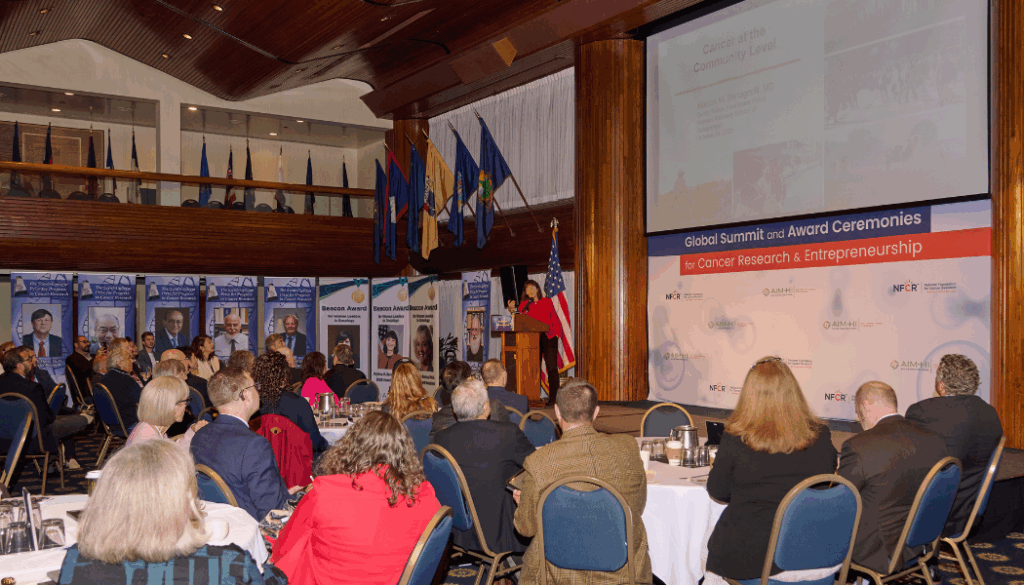
The National Foundation for Cancer Research held its 2025 Global Summit and Award Ceremonies for Cancer Research & Entrepreneurship on October 24 at the National Press Club in Washington, D.C., convening an extraordinary community of leading scientists, clinicians, entrepreneurs, and supporters united by one purpose: to conquer cancer together.
We celebrated innovation and collaboration. We honored one of the true giants in biomedical science whose seminar discoveries led to more than 80 drugs for patients.
From exploring how artificial intelligence is transforming cancer discovery to spotlighting the next generation of oncology startups, and dialogues on the importance of patient-centric cancer research and care. The Summit captured NFCR’s enduring mission: to connect people, science, and innovation in the pursuit of cures.
It is truly a day of forward-looking discussions and groundbreaking ideas.
This Recap is Part One of a three-part series, focusing on Session One: New Frontiers in Cancer Research—don’t miss out on any of the updates, be sure to read part two below!
AI: The Next Frontier in Cancer Research
The day began with a keynote address from Monica M. Bertagnolli, M.D., the 17th Director of the National Institutes of Health and Senior Fellow in Healthcare Policy at the Harvard Kennedy School of Government. In her talk, “Cancer at the Community Level,” Dr. Bertagnolli emphasized that while AI tools are advancing rapidly, true progress depends on connecting technology with people in various communities.
“Healthcare that works in Washington, D.C., might not work in rural Wyoming,” she reminded the audience. “We must ensure AI breakthroughs reach every community.”
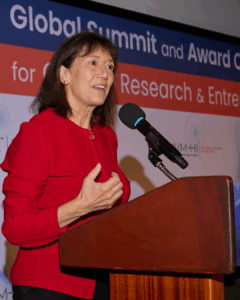
She points that the way healthcare data are collected, processed, and shared must evolve to transform real-world information into actionable insights that deliver immediate benefit to patients, clinicians, researchers, and policymakers. “AI datasets will not succeed in the real world,” she cautioned, “without a dramatic change in how health data from individual people are acquired and used.”
Her keynote set the tone for a day defined by discovery, dialogue, and cross-disciplinary collaboration.
See Also: Dr. Monica Bertagnolli’s Keynote Speech at the 2025 NFCR Global Summit >>>
Precision Medicine and the Rise of the “Molecular Avatar”
The morning’s first panel, AI in Cancer Research: From Discovery to Societal Impact, was moderated by Kornelia Polyak, M.D., Ph.D., of the Dana-Farber Cancer Institute, and featured leading scientists Alexander Anderson, Ph.D. (Moffitt Cancer Center), Jeffrey A. Golden, M.D. (Cedars-Sinai Medical Center), Bruce E. Johnson, M.D. (Dana-Farber Cancer Institute), and Dan Theodorescu, M.D., Ph.D. (University of Arizona Cancer Center).
Together, they explored how computational modeling, digital pathology, and advanced data integration are changing the way cancer is understood and treated.
Dr. Anderson presented new methods in mathematical modeling and “digital twin” simulations, which allow researchers to predict tumor behavior and therapy responses virtually before they reach clinical trials. Dr. Golden highlighted how AI-powered pathology can identify subtle tumor variations invisible to the human eye, accelerating diagnosis and expanding access to precision care.
Dr. Theodorescu introduced the concept of the “molecular avatar”—a virtual patient built from genomic, proteomic, and radiomic data that could one day allow clinicians to simulate treatment outcomes and personalize care for each individual.
The panel agreed that AI’s promise depends on the quality and representativeness of data. “Garbage in, garbage out,” one panelist noted. “AI is only as good as the information we feed it.” While AI can recognize massive patterns across populations, the speakers stressed that human insight and empathy remain essential at the bedside.
AI in Diagnosis and Management: Augmentation, Not Automation
The second panel, AI in Cancer Diagnosis and Management, moderated by Jennifer R. Grandis, M.D. (University of California, San Francisco), examined how AI is transforming the clinical environment.
Dr. Ruijiang Li (Stanford University) explained how foundation models—large, pre-trained AI systems—are revolutionizing diagnostic imaging, identifying patterns invisible to human perception. Dr. Paul Macklin (Indiana University) described evolving digital-twin models that update in real time with patient data to forecast treatment outcomes,
Dr. Maximilian Diehn (Stanford University) presented his team’s work on multimodal AI that integrates liquid biopsy data, imaging, and genetics to detect trace cancer signals earlier and more accurately, while Dr. Kun-Hsing Yu (Harvard University) discussed algorithms that quantify uncertainty, helping clinicians know when to trust AI predictions and when to rely on human judgment.
Their shared conclusion: AI should augment the art of medicine—not automate it.
AI in Early Detection and Prevention
Moderated by Nathan Lear (AstraZeneca), the third session, AI in Early Detection and Prevention, explored how multi-modal data can detect disease risk before symptoms appear. Dr. Ludmil Alexandrov (UC San Diego) shared models identifying mutational “signatures” linked to environmental exposures. Dr. Lisa Coussens (Oregon Health & Science University) and Dr. Elana Fertig (University of Maryland School of Medicine) discussed how AI integrates immune and spatial biology data to reveal early warning signs of cancer development.
Dr. Samir Hanash (The University of Texas MD Anderson Cancer Center) urged a balanced approach: “AI’s role in prevention isn’t more screening—it’s smarter screening.”
Each discussion reinforced that while AI is extraordinary at detecting large-scale patterns, medicine remains fundamentally human. The technology’s success will rely on collaboration, data transparency, and ethical design.
A Call for Collaboration: Dr. Anna Barker’s Vision for the Future
Following the morning’s sessions, Anna D. Barker, Ph.D., Chief Strategy Officer at the Ellison Medical Institute and Co-Founder of the National Biomarker Development Alliance, spoke about the broader implications of AI for science and society.
Dr. Barker described AI as “the most exciting scientific advancement of our lifetime,” capable of reshaping not only cancer research but the global economy. She stressed that realizing AI’s potential requires collective action. “Researchers, nonprofits, and organizations must group together—share information, share data, and work collectively,” she said.
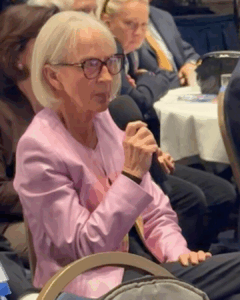
She also warned that governments cannot lead this revolution alone. “This won’t come from the top down,” she said. “It will come from the scientists, innovators, and private organizations that are willing to move fast and think boldly.”
At the same time, Barker called for urgent attention to the ethics and guardrails of AI. “It’s still the wild west,” she cautioned. “We need to define what responsible AI in science looks like—because at this moment in history, we have everything to gain.”
Sign-up to Stay Informed About Cancer Research Breakthroughs with NFCR!
About the NFCR Global Summit and Award Ceremonies for Cancer Research & Entrepreneurship
The NFCR Global Summit and Award Ceremonies for Cancer Research & Entrepreneurship is a signature annual gathering where the leaders driving the future of oncology come together under one roof to challenge the status quo, reveal bold ideas, share insights, and spark collaborations that shape what’s next in cancer research and patient care.
It is designed to catalyze new collaborations, foster new ideas, and develop action plans, all organically generated and mutually stimulated through real-time, provocative, and thoughtful discussions. This event convenes the leading voices shaping cancer research, provides direct access to innovators and investors, and takes place at the National Press Club — a historic venue known as the stage where major developments are announced to the world.
A world without cancer is possible. Help us turn lab breakthroughs into life-saving realities.

5.7 Million+
Donors who have fueled NFCR’s mission

$420 Million+
Invested in high-impact research & programs

36+ Labs & Hundreds of
Nobel Laureates & Key Scientists received NFCR funding, driving breakthrough research