
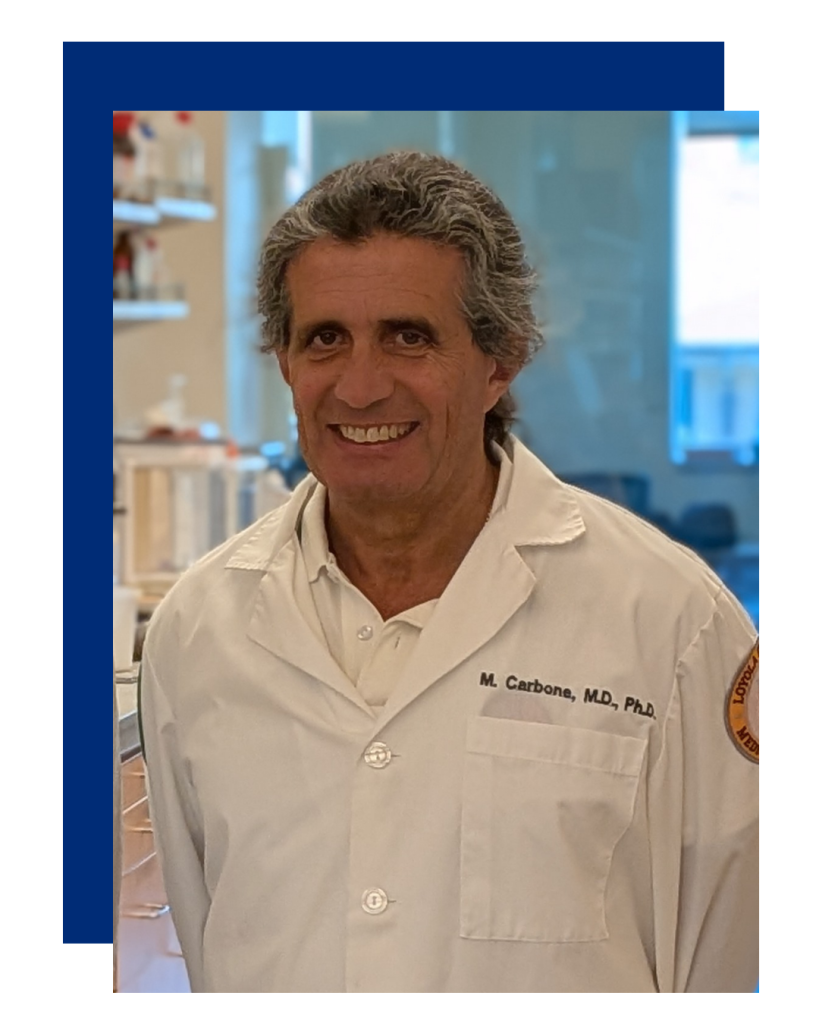
Dr. Michele Carbone is pursuing a revolutionary approach to cancer research: helping the body resist cancer invasion and improving survival for patients worldwide.
For decades, Dr. Michele Carbone’s discoveries have transformed how scientists understand, diagnose, prevent, and treat mesothelioma and other cancers. Today, his research is pursuing a new question with the potential to impact countless lives: Can we make patients more resistant to cancer itself?
Dr. Carbone’s latest research centers on a remarkable scientific paradox.
Individuals who inherit BAP1 mutations are more likely to develop certain cancers. Yet when these cancers occur, they often grow more slowly, invade less aggressively, and patients frequently survive far longer than expected.
Building on his previous breakthroughs, Dr. Carbone’s team is investigating:
- The biological factors that limit cancer invasion
- The role of genetics in long-term survival
- How the tumor microenvironment influences cancer progression
- New strategies to improve outcomes for patients with aggressive cancers
The ultimate goal is to develop therapies that help more patients resist the spread of cancer and live longer, healthier lives.
If you would like to donate stock to support this work, please complete an electronic stock transfer using the details below:
DTC Broker: Charles Schwab
DTC Number: 0164
Attention: Charles Schwab
Broker Address: 3000 Schwab Way, Westlake, TX 76262
Account #: 8727-1381
Account Name: National Foundation for Cancer Research
If you would like to donate via mail, please send all donations to:
National Foundation for Cancer Research
5515 Security Lane, Suite 1105
Rockville, MD 20852
Attn: Dr. Carbone’s Research
More About Dr. Michele Carbone
A Pioneer in Cancer Discovery
Dr. Michele Carbone is a world-renowned physician-scientist whose groundbreaking discoveries have changed the understanding of mesothelioma and inherited cancer risk. His research led to the discovery of the BAP1 Cancer Syndrome. This transformed the field’s understanding of mesothelioma and opened new opportunities for prevention, early detection, and treatment.
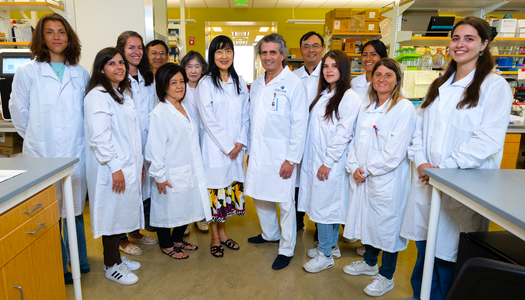
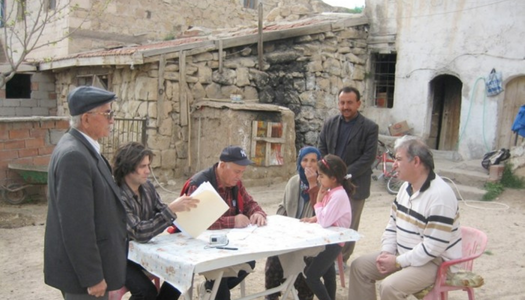
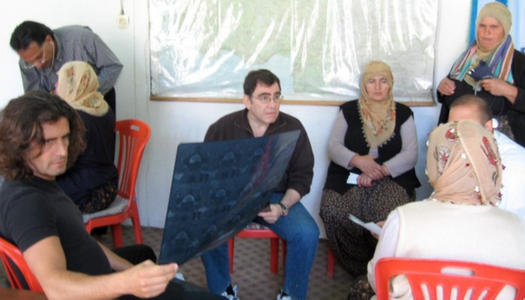
Studying an epidemic of mesothelioma in remote Turkish villages, Carbone discovered that in some families the susceptibility to mesothelioma and to other cancers was transmitted in a Mendelian fashion (autosomal dominant inheritance). Studying US families affected by multiple cases of mesothelioma, Carbone and his team identified the gene responsible, BAP1, elucidated the molecular mechanisms, and named this condition the BAP1 Cancer Syndrome. Carbone enrolled 47 BAP1-mutant families and followed them for 20+ years, implementing early-detection strategies. He discovered the unique histological, immunohistochemical, and biological characteristics of genetically induced mesotheliomas that set them apart from asbestos-induced mesotheliomas. His findings led to significantly improved survival and curative resection of early-stage cancers, saving many lives from a malignancy that until recently was deemed untreatable. BAP1 genetic testing and BAP1 immunohistochemistry for mesothelioma diagnosis are now routine in medicine. Moreover, in rural North Dakota and in Cappadocia, Carbone effected government policy changes, removing erionite, rebuilding two new villages, and relocating susceptible populations in erinite/asbestos-free areas, saving future generations from mesothelioma. Today, patients around the world benefit from genetic screening, surveillance programs, and clinical advances made possible by his research.
Dr. Carbone’s Discovery That Saved Lives
Dr. Carbone’s work has led to real-world public health action that continues to save lives today.
His research identified the deadly interaction between inherited BAP1 mutations and exposure to carcinogenic mineral fibers, such as erionite. These discoveries prompted major public health interventions, including:
- Relocating Turkish villages away from dangerous environmental exposures
- Establishing long-term surveillance and early detection programs
- Identifying cancer risks linked to erionite-contaminated roads in North Dakota
- Supporting road paving initiatives that reduce future exposure risks
- Developing diagnostic tests now used worldwide for patients with BAP1-related cancers
This work demonstrates how pioneering research can have a lasting impact on generations of families.
For patients and families facing mesothelioma and other devastating cancers, Dr. Carbone’s work has been life-changing — and the scientific community has taken notice. In recognition of his transformative impact on cancer research, Dr. Carbone has been awarded the 2026 Szent-Györgyi Prize, NFCR’s highest honor for scientific progress that brings real hope to patients in critical need.
Want to hear Dr. Carbone tell his story in his own words? He joined NFCR President & CEO Dr. Sujuan Ba on All Things Cancer, NFCR’s podcast, to discuss his discoveries, the patients behind the research, and what’s coming next.

Want to discuss Dr. Carbone’s Research further with our Team?
Fill out this form to let us know you would like to connect, and our team will reach out to schedule a meeting!