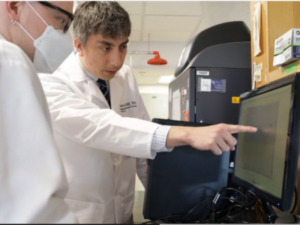

Robert Bast, Jr., M.D.

University of Texas M.D. Anderson Cancer Center
Houston, Texas

mdandersonlogo

Targeting Ovarian Cancer

Ovarian cancer, often called "the silent killer", is a leading cause of death from gynecologic cancers. It is estimated that 15,460 American women will die from ovarian cancer in 2011 alone. Located deep within the pelvis, symptoms are often ambiguous and difficult to detect, even on pelvic examination. Too often ovarian cancer goes undiagnosed until after the disease is far advanced and spread throughout the abdomen. When diagnosed early, ovarian cancer can be cured in more than 90% of cases, but after it has metastasized, survival rates plummet. Chemotherapy will shrink a majority of ovarian cancers, leaving patients apparently cancer free. However, microscopic nests of drug resistant cancer cells oftentimes remain dormant-sometimes for years-before growing progressively to kill the patient.

robert_bastDeveloping early diagnostic tools - it began with CA125

NFCR Project Director, Robert C. Bast, M.D., is a world leader in ovarian cancer research. In 1981 he discovered CA125, the first clinically useful tumor biomarker for monitoring the course of patients with epithelial ovarian cancer. Today a blood test for CA125, in combination with transvaginal ultrasound and thorough pelvic exams, may help in diagnosing patients with ovarian cancer. But further research is needed to understand how to better use this biomarker in a clinical setting.

While many have decried the lack of attention and research funding to ovarian cancer, NFCR has devoted a great deal of energy and resources to give women reason to hope for new and better treatments for ovarian cancer. While there is as yet no new, approved tumor biomarker test for ovarian cancer to complement the CA125 biomarker, in the past 10 years there has been an explosion of research on ovarian cancer biomarkers and an explosion of knowledge on ovarian cancer. Much of this is being made possible by NFCR scientists at the M.D. Anderson Cancer Center in Houston, where Dr. Bast and his team are located. They are developing new biomarkers for the early detection of ovarian cancer as well as new methods to eliminate dormant drug resistant cancer cells.

Discovering new therapies to treat ovarian cancer

In addition to his efforts to develop essential tools for early detection and diagnosis of ovarian cancer, Dr. Bast is also focused on discovering new therapies that oncologists can use to treat ovarian cancer. With NFCR support over the past decade, Dr. Bast has pioneered research to define molecular alterations in ovarian cancer that might serve as targets for novel ovarian cancer therapies.

Specifically, Dr. Bast and his team have discovered ARHI, a novel tumor suppressor gene that may prove useful for gene therapy. They found that the level of the ARHI protein is normal in ovarian epithelial cells, but is lowered in the majority of ovarian cancers where the ARHI gene is either deleted or silenced due a biochemical process called DNA methylation. Further investigation by Dr. Bast and his team showed that the decreased level of the ARHI protein significantly contributes to ovarian cancer development and is inversely correlated with patient outcome.

Development of ovarian cancer model

This is good news, for Dr. Bast found that by reactivating ARHI in cancer cells in the laboratory he could inhibit the growth and invasiveness of those cells. Recently, he and his team have developed an experimental model that can switch dormant or "sleeping" ovarian tumor cells on and off to control the production level of the critical gene, ARHI. This procedure allows researchers a new advancement into the understanding of ovarian cancer because these changing levels of ARHI genes are similar to what is observed in ovarian cancer patients. Moreover, using their unique model the Bast team has identified "survival factors" in the tumor environment that allow the dormant tumor cells to survive. Inhibitors of the survival factors are being tested in the model to determine which has the most potential to become a new and effective therapy for patients with ovarian cancer.

Breakthrough discoveries of new targets to enhance chemotherapy

Only about half of women with ovarian cancer will respond to the standard chemotherapy agent, paclitaxel, which is better known by its brand name, Taxol®. Dr. Bast's team is conducting cutting-edge siRNA experiments to identify proteins in cancer cells that may regulate sensitivity to Taxol. SiRNAs are strands of genetic material involved in decoding DNA instructions and reducing production of particular proteins in the cell. By testing a collection of siRNA molecules on ovarian cancer cell lines, the team has identified 14 siRNAs that alter the cancer cell's sensitivity to Taxol. One siRNA identified the protein, SIK2, which is normally associated with cell metabolism, but in these experiments SIK2 also inhibited cell division. When SIK2 was inhibited with its siRNA, the sensitivity to Taxol was increased in the ovarian cancer model. This opens the drug discovery path to identify inhibitors of SIK2 for treating patients in clinical trials. The other 13 siRNAs are also being tested individually and in combination to determine whether reducing production of multiple proteins through the action of siRNA in tumor cells can further enhance tumor sensitivity to Taxol. When the optimal combinations have been identified in ovarian cancer cell lines, siRNAs and Taxol can be also be utilized in the new model developed in the Bast lab. Because of the similarities between this powerful model and the actual disease in humans, new therapeutics can be rapidly moved into clinical trials to treat ovarian cancer patients. If Dr. Bast's approach is successful, the rate of response to Taxol and the survival of ovarian cancer patients will improve, giving them renewed hope of conquering their disease.

NFCR has been supporting Dr. Bast's cutting-edge research since 2001, offering hope and promise to women with ovarian cancer-giving their doctors a new weapon with which to fight this lethal disease. "By understanding the biology of individual cancer cells and their interaction with other cells in the body, we will develop more effective approaches to eliminate ovarian cancer as a threat to all women," said Dr. Bast. This is what continuing support from the National Foundation for Cancer Research will make possible.

Impact on Cancer Prevention, Treatment, or Cure

By evaluating potential tumor suppressor genes for ovarian cancer, studying the expression of specific genes, and mapping genes that could be harnessed to inhibit tumor growth, Dr. Bast and his laboratory are bringing us closer to using gene therapy to prevent ovarian cancer ... and at the very least, to detect this deadly cancer early, when it is most treatable. Because of the similarities between Dr. Bast's new experimental model and the actual disease in humans, new therapeutics can be rapidly translated into clinical trials to treat ovarian cancer patients and give them renewed hopes. The data generated from this unique model of ovarian cancer now provides the framework for answers to how to eliminate these dormant cells that reside not only in ovarian cancer, but in breast cancer and perhaps other malignancies, which could provide broad benefits to more cancer patients.

To support this and similar research, click here or call 1-800-321-CURE (2873).


Sign Up Now!

Sign up now to receive cancer prevention tips, research updates, monthly recipes, news and events, and more!

Name:
Email:


NFCRfacebook2 NFCRtwitter2 causes