
Research Update: Computational Modeling for Personalized Treatment
A group of researchers, whose work has been supported by the National Foundation for Cancer Research (NFCR), has created a powerful piece of software that allows scientists to model tumor growth, immune responses, and treatment outcomes in a virtual environment.
The study, which appears in Cell, uses genomic data together with sophisticated computational modeling to predict how cancer cells and immune cells interact and develop, and thus gives researchers a strong, computer-based tool with which to examine treatment possibilities in conjunction with laboratory models and clinical trials, without having to incur the costs or risks to patients.
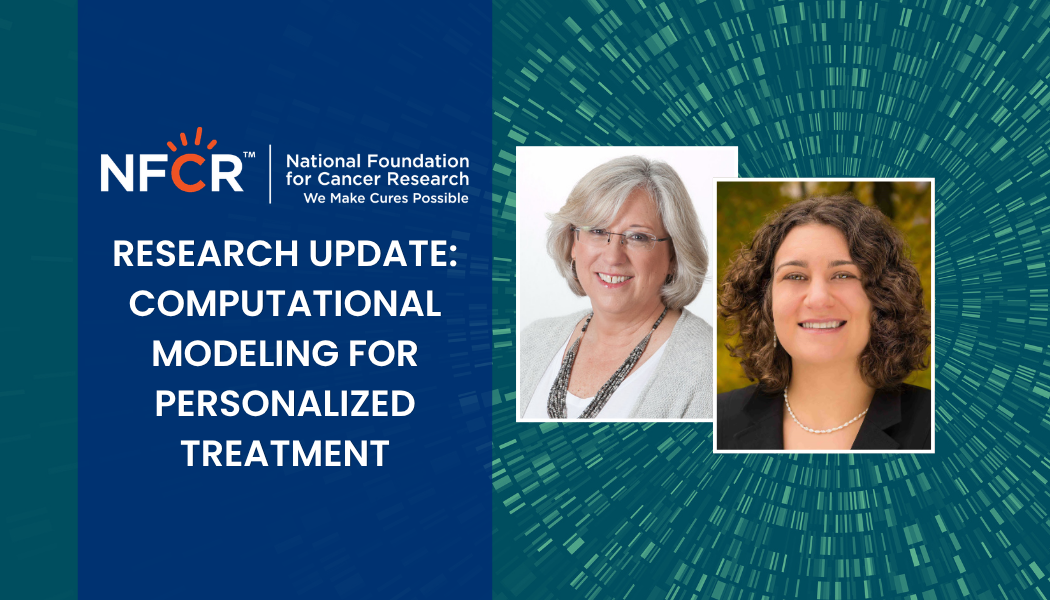
The study was jointly led by a research team that was funded by the NFCR, consisting of Dr. Lisa M. Coussens from Oregon Health & Science University (OHSU), who is an expert in tumor immunology, and Dr. Elana J. Fertig from the University of Maryland School of Medicine (UMSOM), who is a leader in the fields of mathematical modeling and genomics. Dr. Coussens provided single-cell atlases of tumor environments, and Dr. Fertig’s team conducted simulations to examine how tumors in preclinical models might respond to different treatment scenarios.
“This gives us a new, in silico approach to explore complex cancer dynamics,” said Dr. Fertig. “It’s like a weather model — but for cancer biology.”
The study was the product of extensive collaboration across institutions, involving other leading researchers from Indiana University, Johns Hopkins University, OHSU, and UMSOM; a notable aspect of the work was the “hypothesis grammar” developed by Dr. Paul Macklin’s team at Indiana University, which converts biological theory into computational logic.
“Breast cancer is notoriously difficult to treat,” said Dr. Coussens. “By modeling how immune cells like macrophages impact tumor growth, we can better predict which treatment combinations may be most effective.”

Dr. Sujuan Ba, President and CEO of NFCR, praised the project’s cross-disciplinary teamwork: “This project embodies our mission — bringing together scientific minds across disciplines to accelerate the discovery of better treatments and cures. Computational modeling is a powerful addition to the cancer research toolbox.”