Research by Type:
| Wei Zhang, Ph.D. |
|
M.D. Anderson Cancer Center
Development of a new biomarker and therapeutic target for colorectal cancer In the United States, an estimated 101,340 new cases of colon cancer and 39,870 new cases of rectal cancer were expected to occur in 2011. In fact, colorectal cancer is the third most common cancer in both males and females and accounts for about 9% of cancer deaths each year. Great progress has been made in the treatment of colorectal cancer as death rates from this disease have decreased over the past two decades in the United States. However, 36% of patients with colorectal cancer only survive less than five years after diagnosis. New and more effective therapies will produce a major improvement in the survival rates among colorectal cancer patients. Cutting-edge research grounded in the newest technologies seeks to discover new biomarkers associated with colorectal cancer. These biomarkers are essential to the development of new tools for diagnosis and better treatment options for patients with colorectal cancer.
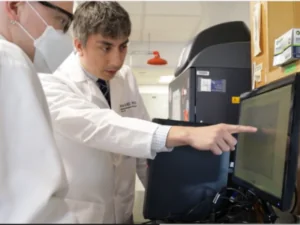
NFCR Project Director Wei Zhang, Ph.D., at M.D. Anderson Cancer Center, is conducting cutting edgegenetic research to discover a new biomarkers and therapeutic targets for colorectal cancer. Although studies of genes and proteins over the past 10 years have produced potential candidate markers, more in-depth investigation is required to determine whether these marker genes are key oncogenes (cancer promoting genes) that initiate the abnormal pathways that give rise to colorectal cancer. Through a series of analyses using tumor samples from colorectal cancer patients, Dr. Zhang discovered that NGAL, a protein normally expressed in white blood cells, is produced in abnormally high amounts in colorectal tumors. NGAL expression was associated with cancer stage and tumor recurrence in stage II patients. His team has determined that NGAL expression in cancer cells was a factor for a poorer outcome. Importantly, their research suggested that NGAL is important for tumorigenesis and progression of colorectal cancer. Current Research MicroRNAs (miRNAs) are small, non-coding RNAs that regulate expression of target genes through RNA interfering mechanism or translational inhibition. Recently, accumulating evidence has indicated that aberrant expression of miRNA signatures is associated with cancer development and progression. Wei Zhang has begun to investigate the potential of circulating miRNAs in the blood as biomarkers. In a proof-of-principle study, Dr. Zhang identified and validated that miR-141 was a novel plasma marker that complemented carcinoembryonic antigen, another known marker, in detecting advanced colorectal cancer patients, and that plasma miR-141 is associated with poor survival in those patients. Early Detection of Colorectal Cancer By using high-throughput technology, Wei Zhang has profiled close to 1,000 microRNAs in blood of 40 colorectal cancer patients of different stages and healthy people as controls, identifying candidate microRNAs that are indicative of early stage cancer. This important research is ongoing to narrow down those miRNAs that are the most effective predictors of early stage colorectal cancer. Impact on Cancer Prevention, Treatment, or Cure Dr. Zhang's research on NGAL suggests that it may become a new biomarker for early diagnosis and for evaluating prognosis of patients. It holds promise as a therapeutic target for treatment of colorectal cancer. His current research on plasma miRNAs markers hold important clinical relevance and could give oncologists new diagnostic tools for colorectal cancer, giving people hope that colorectal cancer can one day be detected earlier. Successful completion of Wei Zhang's NFCR research will have a long lasting impact on management of colorectal cancer and will likely change the current practice of colorectal cancer detection and prognosis. Dr. Wei Zhang is a powerful example of how NFCR funding is paving the way for new and more effective cancer detection approaches and treatments that save more lives.
|


Project Director and Research