NFCR Center for Molecular Imaging


Center Director:

James P. Basilion, Ph.D.
Case Western Reserve University, Cleveland, OH

caselogo

The Problem

As cancer progresses with time, it becomes more deadly if undetected. If cancers are found and treated at their earliest stage, the chance of survival dramatically increases. However, today's cancer imaging technologies such as ultrasound, CT scans and MRI, often fail to detect small, newly formed cancers. Consequently, these methods have significant limitations in early cancer detection.

The Solution

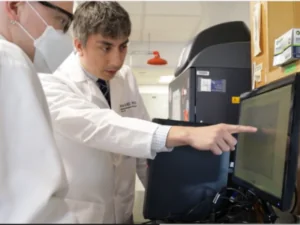
james_basillionDirected by James P. Basilion, Ph.D., the NFCR Center for Molecular Imaging at Case Western Reserve University is focused on developing new molecular diagnostic tools which can "see" cancer cells at the molecular level through visualizing cancer-specific biomarkers. This advanced technology called molecular imaging may help detect cancer at early and more treatable stages.

Traditional imaging technologies rely on detecting different physical properties (e.g. shape, density, etc.) between cancers and their surrounding normal tissues, which are often insensitive and unreliable. In contrast, molecular imaging uses probes known as biomarkers to help visualize very fine cellular and molecular properties that are specific for cancer cells, thus result in a substantial increase in the sensitivity and specificity of medical imaging, allowing cancer to be diagnosed at the very early stages when it is still tiny. In addition, because it is a non-invasive method (no tissue samples need to be taken from the patients), molecular imaging has also become a critical tool for evaluating treatment efficacy, monitoring the earliest signs of cancer recurrence, and developing new anti-cancer therapies that are more tailored to individual patients.

The Research

The work taking place at the Center seeks to base the image that the clinician views not on anatomical differences but rather on molecular and biochemical differences that exist between cancer and normal tissues. These molecular differences are much larger than anatomical differences and are detectable far earlier than are differences in tissue density or other anatomical differences resulting from cancer. The Center is currently focusing on identifying molecular markers specific to cancers such as breast, prostate, and brain cancer, and developing imaging tools to make these markers visible.

CRIP1 Protein for Detecting Breast Cancer

Dr. Basilion and his collaborators have found that CRIP1, a protein presented in abnormally high amounts in 90% of breast cancer cases, could be an ideal genetic marker for detecting breast cancer at earlier stages when it cannot be detected by current technologies. Building on this discovery, Center researchers are now developing the first imaging tools that can visualize the presence of CRIP1 through a target-specific fluorescent probe (agents which bind to CRIP1 and emit light to facilitate its detection). The light emitting probe is many times more sensitive than existing probes and will allow clinicians to directly see the changes in the production and location of the CRIP1 molecules. New imaging tools such as the CRIP1 probe will greatly assist physicians in making appropriate and personalized diagnostic analysis for each patient in the earliest stage of their illness.

Improving Surgical Removal of Tumor Cells in Glioblastoma

Another unmet clinical need is the capability to identify and surgically remove all the cancerous tissue and individual cancer cells infiltrating into surrounding normal tissue. For aggressive brain tumors such as glioblastoma, this type of technology is of utmost importance since its hallmark is infiltrating cancer cells. A sad reality for almost all glioblastoma patients is their experience of the return of their cancer post-surgery and after combined chemoradiation therapy. Recently, Dr. Basilion's team has developed a technology that makes tumor biomarkers visible within minutes and allows surgeons to quickly identify the infiltrating tumor cells from the glioblastoma, providing invaluable assistance during an operation and in improving surgical removal of tumor tissue. Further enhancements to this technology by Dr. Basilion and Center researchers may lead to better outcomes for patients with this very aggressive type of brain tumor. Similar technology is being developed for detection of infiltrating cells in breast cancer and other types of cancer.

Early Detection of Cancer

The NFCR Center for Molecular Imaging has made substantial progress in developing molecular imaging techniques which allow simultaneous imaging of multiple molecular markers, dramatically increasing the accuracy of cancer detection. Information that relies on the expression and imaging of only single gene markers is useful, but it can be misleading. For example, markers which are over-expressed in diseases tissues are also expressed in normal tissues in a spatio-temporal manner making interpretation of the results in a diagnostic setting potentially difficult.

Dr. Basilion's research has demonstrated that simultaneous measurement of more than one of these gene markers is more predictive of disease. Many tumors contain cancerous cells that tend to over-produce certain "combinations" of cancer-causing molecules or biomarkers on their cell surfaces that, together, cause the early progression of abnormal cell growth. Dr. Basilion's team is currently developing specific probes that bind simultaneously to critical multiple biomarkers. Injectable probes would circulate through the bloodstream and seek out the biomarkers. Molecular imaging with a camera may produce a visual record of the collection of these early biomarkers on the whole surface of a very small tumor. With this image, doctors will be able to detect many cancers at their earliest stage, and more accurately than is possible using existing detection methods that sample only small areas of tumors from biopsy, yielding only partial information. This unique advantage of molecular imaging may allow the early diagnosis that patients need and deserve to improve their chances of surviving many types of cancer. Research of this invaluable technique is ongoing.

Impact on cancer detection, prevention and treatment

Molecular imaging technology will significantly increase sensitivity and specificity for detecting disease markers and will pave the way for development of tools able to image non-invasively complex molecular signatures of disease. The techniques developed in the Center have broad applications for developing advanced imaging tools for early detection of cancer and holds great promise in saving more patients' lives. The novel molecular imaging technology has become a critical tool to guide surgeons in the complete removal of cancer cells that infiltrate normal tissue, giving patients more hope that the cancer will not reoccur. Molecular imaging allows monitoring of the earliest signs of cancer recurrence so patients can receive the proper treatment at the right time. With their tireless efforts, these NFCR scientists not only develop advanced technologies, but also bring hopes to millions of cancer patients who are suffering from this devastating disease.


detect many cancers
 

Sign Up Now!

Sign up now to receive cancer prevention tips, research updates, monthly recipes, news and events, and more!

Name:
Email:


NFCRfacebook2 NFCRtwitter2 causes