Research by Type:
| NFCR Center for Targeted Cancer Therapies |
|
Center Director and Co-Director Daniel Von Hoff, M.D. & Laurence Hurley, Ph.D.
To read the press release announcing a renewed three-year, $600,000 grant to study targeted cancer therapies from NFCR to NFCR Center for Targeted Cancer Therapies, click here. In 2011, an estimated 44,030 individuals will be diagnosed with pancreatic cancer, and approximately 37,660 people will lose their battle with this disease. Pancreatic cancer has the lowest survival rate of all types of malignancies, with the one-year relative survival rate at 26% and the five-year survival rate only about 6%. Two main reasons account for the extremely low survival rate of this disease. First, pancreatic cancer patients seldom exhibit disease-specific symptoms until later stages, and in more than 90% of patients the tumor is already at an advanced stage upon diagnosis. In addition, the treatment options currently available for pancreatic cancer are limited and ineffective.
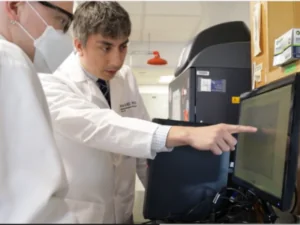
NFCR Center for Targeted Cancer Therapies (NCTCT) at TGen, Arizona, is dedicated to discovering novel and effective therapeutics to treat pancreatic cancer. The center is co-directed by Dr. Daniel Von Hoff, one of the top oncologists in the United States and a leading scientist in the field of cancer research, and Dr. Lawrence Hurley, a renowned medicinal chemist in the field of drug screening and development at the University of Arizona. Led by Drs. Von Hoff and Hurley, researchers at NCTCT have been developing new therapies which block the growth of pancreatic cancer cells by interfering with pancreatic cancer-promoting molecules - an approach called targeted cancer therapy. While traditional chemotherapeutic drugs function through impairing cell division in a general way, targeted therapies specifically kill cancer cells and leave normal cells unharmed, resulting in enhanced cancer-killing power with less side effects. As pancreatic cancer cells often become resistant to chemotherapy and radiation, targeted therapies may offer new treatment options to kill resistant cancer cells. In the past few years, NCTCT has made enormous progress in identifying potential new targets and developing new targeted therapies for pancreatic cancer. YAP1 Gene - a potential new candidate for targeted therapy One area has focused on the YAP1 gene which is a candidate cancer-causing gene (or oncogene) in liver cancer. First, Center researchers demonstrated that the YAP1 gene is highly active in tumor samples taken directly from pancreatic cancer patients. The team has recently demonstrated that inhibition of YAP1 expression in laboratory pancreatic cancer cells reduces their ability to proliferate and grow and increases their likelihood of dieing a normal cell death. With these positive laboratory results, center researchers are currently developing molecules that inhibit YAP1 function as new therapeutic agents against pancreatic cancer. Enhancing the Sensitivity of Current Targeted Therapy In a second research project, Center researchers are looking for ways to manipulate tumor cells and make them more sensitive to erlotinib (trade name Tarceva®)-the FDA-approved drug for pancreatic cancer treatment. Their recent experiments have identified inhibitors of an enzyme called MEK and demonstrated the inhibitors significantly boost the treatment efficacy of erlotinib when used together in pancreatic cancer cells lines and tumor models. With these encouraging results, Dr. Von Hoff is planning a clinical trial to treat patients with the combination of the inhibitor plus erlotinib. Targeting a Mutant Gene Expressed in Pancreatic Cancer A third research project focuses on the development of inhibitors of the KRAS gene - a gene which signals cells to proliferate, migrate, and survive. A mutation in the KRAS gene causes K-ras proteins to be constantly produced in more than 95% of pancreatic cancers. Therefore, inhibition of this mutant gene will have profound effects on the growth of pancreatic cancer cells. Drs. Von Hoff and Hurley have identified several promising lead compounds that inhibit growth of pancreatic cancer cell lines expressing the mutant KRAS gene. In addition, the researchers discovered that the compounds also target two other genes that are important in killing pancreatic cancer cells. This exciting preliminary data is providing an excellent starting point for the next phase of targeted drug optimization. Significance and Impact Pancreatic cancer is the most deadly form of all types of cancer and new therapeutic strategies are in desperate need to save lives of patients. The NFCR Center for Targeted Cancer Therapies at TGen (NCTCT) is dedicated to developing novel targeted cancer therapies against pancreatic cancer. The combination of Dr. Von Hoff's expertise in cancer biology and oncology and Dr. Hurley's expertise in chemistry and drug development is accelerating the translation of novel targeted therapies into clinical applications. The continued funding from NFCR of the Center since 2002 has allowed these researchers to yield fruitful results in the search for pancreatic cancer targeted therapies, brining new hope to pancreatic cancer patients.
|

Developing New Targeted Therapies Against Pancreatic Cancer